
Musicians work with a subtle material of emotion. In a creative process, it often happens that the initial idea of the piece gets covered by many possible interpretations appearing on the way. Many musicians find a struggle in delivering exactly what they want, keeping things in order when composing. Of course, a bit of chaos is an essential part of a creative process, yet, after all, we all expect a certain result. To help solve the problem of being stuck, Waestrai magazine suggests getting to know ways of musical organization.
- Musical form
Every piece possesses a structure: a system in which parts are put together. In music, it is called musical form. Most of the popular modern compositions have the song form that would be a variation of this plan: intro > verse > pre-chorus > chorus > verse > pre-chorus > chorus > bridge > chorus. But generally, musical form can be made up in any way that delivers a desired concept. There are some classical and famous musical forms to consider:
Single form — A. The smallest unit, where A is the period;
Binary form —A B;
Tripartite form — A B A;
Rondo — A B A C A D A…;
Variative form — A A(1) A(2) A(3), where (1), (2), and (3) are variations of A.
Sonata form — exposition > development > recapitulation.
When using a song form or writing any other composition, it is important to plan the goal or function of each part. Every one of them can be divided further into phrases and then motifs.
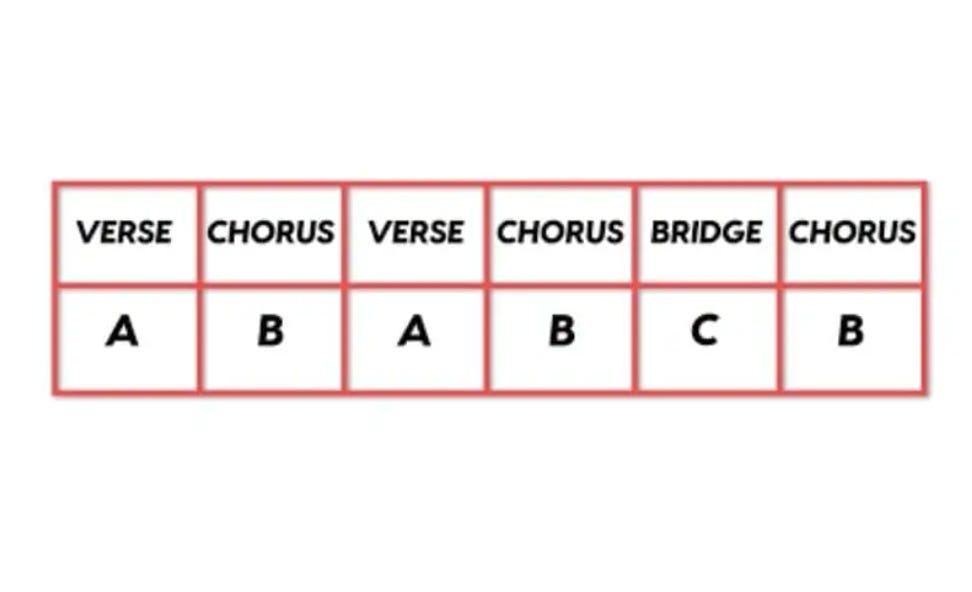
Scheme by Music Gateway
Creating a vision for all elements helps set thoughts in the right direction and diminishes chaos. Each part of a piece should be customized specifically to the author’s idea, which will be kept in mind while composing. It does not block artistic freedom and it is still a creative approach because the concept remains the most important part. Remember that you are in control of everything that happens in your music, while planning is only a tool that helps to make the process more productive.
- Musical texture
While form gives an “outside” view of a piece, texture is what allows us to look inside. It touches upon everything related to the organization of the sound. Texture can be monophonic if there is only one line in progress or polyphonic if there are several. It also refers to the location of the notes: wide or close together. Additionally, for our perception, there is always the main voice and the background ones. In composing using musical texture usually comes to arranging many different voices, making them match with one another and with the leading one. Conscious understanding of how it works allows us to build up every single line to execute its purpose in a piece. Mood in music depends not only on the chosen note sequences but as well on the harmonious combination of all the instruments’ lines. This is why remembering about texture is helpful. Similarly to the situation with the form, we plan each of the lines according to their function. For instance, a bass can outline certain parts of the lead voice, an electric guitar can create a sense of tension, and the strings can make up the feeling of enlightenment. In the process of planning, it is easy to set the imagination free and dig deeply into one’s true vision of the music, widen the perspective, reach new horizons, and, of course, deliver one’s specific truth.

Interestingly enough, musical knowledge operates similar thinking patterns regarding different aspects. This is why working with one of them thoroughly helps to expand the initial idea when proceeding to another. A concept reveals itself when being viewed from different perspectives, through various definitions. Therefore, the problem of not knowing exactly what is happening in a piece gets solved.
In conclusion, understanding how to work with musical form and texture not only helps to create order in the process of composing, but also creates possibilities for enhancing the idea, specifying it, and making it unique. Eventually, hard and accurate work on a piece always pays off afterward, when the sound feels polished, radiates intelligence and self-sufficiency.
Recourses:
- Music Matters – What is texture;
- Study Music;
- Ryan Leach – Polyphonic ORCHESTRATION.
 waestrai.com